Decoupling Deployments from Releases: The End of the War Room
Moving away from monolithic drops is about raw emotional relief for engineers. Here is why you need to separate code from customer impact, and how to assess your blast radius.
Published on April 17, 2026

Remember the sheer dread of the old release day war room? Pizza boxes stacked up, sweaty palms, and everyone praying the monolith wouldn’t crash when the switch was flipped. That kind of white-knuckle event belongs in the past.
We need to get back to a simple truth: Deployment is a technical event. Release is a business decision.
A modern DevOps pipeline isn’t just about how fast your tests run in CI/CD; it’s about decoupling your code drops from your user experience. Moving away from monolithic deployments is ultimately about raw emotional relief for engineers. It completely removes the exhausting ceremony around releases and lets developers just do the heavy lifting of writing code, without carrying the weight of a potential Friday afternoon outage.
Shift Left Requires Shifting Control
The core goal of shift left DevOps is catching issues early, but that only works if your product team actually controls the rollout. Handing feature toggles over to product owners isn’t about losing control of your application. It’s about offloading the stress.
By wrapping new code in a feature flag, developers safely ship dormant code into production. The technical deployment is finished. Product then takes on the business risk of when users actually see it. If you are relying on continuous deployment strategies but still gating releases behind an engineering bottleneck, you’re missing the entire point. You have to be able to limit the blast radius without dragging developers back into the release flow.
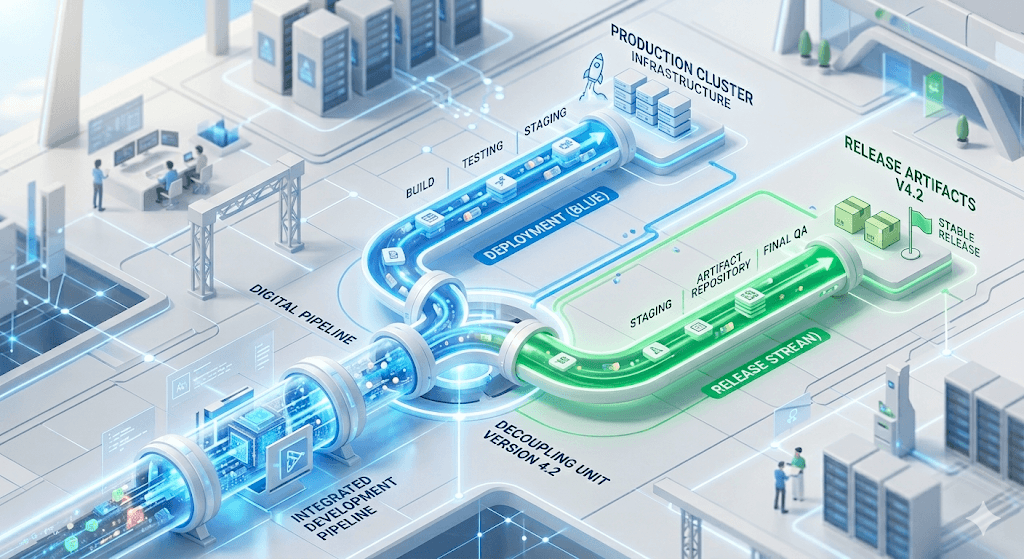
AI Generated Image Prompt: A modern 3D isometric illustration of a heavy, glowing digital pipeline cleanly decoupling into two distinct, safe streams. One stream is blue (deployment), the other is green (release). Bright, optimistic lighting, corporate tech aesthetic.
The Blast Radius Assessment Matrix
To make this workflow a reality, you need a repeatable mental model for how features actually go live. Not all code changes carry the same weight.
Before handing a flag over to Product or deciding on a rollout strategy, run your deployment through the Blast Radius Matrix. This is a simple framework to categorise where the true risk lies:
- Low Technical Risk, Low Business Risk (The Fast Lane):
- Examples: Minor UI tweaks, text changes, or adjusting a frontend layout.
- Strategy: Deploy dark. Hand the toggle to the Product team and let them flip it to 100% whenever marketing is ready.
- Low Technical Risk, High Business Risk (The Product Canary):
- Examples: A controversial new pricing tier or a drastic shift in user workflow. The code won’t break the server, but users might hate it.
- Strategy: Product rolls this out to a 5% canary cohort. Monitor support tickets and conversion rates closely before scaling up.
- High Technical Risk, Low Business Risk (The Engineering Sandbox):
- Examples: A major refactor of a backend service or a database migration that shouldn’t change the user experience at all.
- Strategy: Engineering owns this flag. Target an internal dogfooding cohort first (@yourcompany.com), then slowly dial up traffic while monitoring your p95 latency and DORA metrics.
- High Technical Risk, High Business Risk (The Measured Crawl):
- Examples: Swapping payment gateways or replacing a core downstream API.
- Strategy: Strict, heavily monitored traffic rollout. Start at 1%, keep your finger hovering over the kill switch, and scale only when the logs prove it’s safe.
The Architecture Sniff Test
Having a framework is great, but it brings us to how your tools actually operate under the hood. If your team pushes code hundreds of times a day, introducing network latency for a flag evaluation is an architectural failure.
Think about it: if your application has to make an external HTTP request over the network just to decide whether to render a checkout button, you’ve introduced a massive bottleneck and a single point of failure. Fast, local evaluation is the only way a modern pipeline should ever work. Your application should evaluate flags locally in milliseconds, keeping your architecture robust and your user experience seamless.
Stop Paying the Success Tax
Your infrastructure needs to pass the sniff test commercially, too. You shouldn’t be penalised with a “success tax” or some bloated “enterprise tax” just to get tools that align naturally with a GitOps workflow.
Many platforms will charge you per evaluation or per active user, meaning the more your application scales and the more frequently you test, the more you are punished on your monthly bill. Your infrastructure should pass the sniff test, meaning you shouldn’t have to pay extra for a tool that provides local evaluation and doesn’t slow down your app. At RocketFlag, we believe safe releasing shouldn’t be a luxury reserved for massive enterprise budgets.
Stop fearing your deployments and give it a go. Take your weekends back, let developers write code, and let product own the release.
Ready to build a deployment pipeline that actually scales with your team? Get started with RocketFlag’s free plan today.